Tuesday, May 29, 2012

The fish, the flies

In August this year, will be my first big expedition to start the quest for all of Alaskan game fish. I will make smaller forays during the summer. I will do day trips to Quartz lake and Lost lake for rainbow, char and lakers, I will do some trips to the Salcha river for kings. But the first real expedition will be to the Salmon Fork of the Black River to do a float trip similar to the one Mike and I did last year. On this trip I will try for several species on my list. My primary targets will be arctic grayling, northern pike and sheefish. I also hope to pick up some other species like any of the three whitefish and burbot. Some friends will be accompanying Mike and I on the trip this year, Bob Hook, who I talked about earlier, and Paul Robinson, a long time fishing buddy of Bob's. Both of them are dedicated and experienced fly fisherman and I hope to learn a lot from them.
It's my goal to catch my Alaska 25 on my own fly patterns so, I want to tie flies I have not seen before. It's probable that variations of all of the flies I am going to tie have been done before, but I'm making an effort to stay away from the "go-to" flies, I'm staying away from fly pattern recipes and pictures of flies.
My procedure for each game fish will be to decide on two or three prey species to imitate, research that prey animal, and tie flies from pictures of the prey animal. In my research I will discover what stages of the life cycle my food species will be in when I plan to fish, as well as their ranges, color phases, size and other things.

GRAYLING
There are lots of effective grayling flies, almost any dry fly will work, as well as nymph and egg patterns.
I have decided on three that I think will be a lot of fun.
A moth, a bumble bee and a stink bug.
There's a little white moth that I have often seen fluttering over streams in the fall, I have seen grayling feed on them and I have dangled small spinners inches above the surface of the water like a moth, enticing grayling to jump at it. I'm sure a Light Cahill would do nicely to imitate this moth, but I am on another mission.
In my research, I learned that the moth is likely a spruce bud worm moth. In many parts of their range they are bigger and darker, but up here in northern Alaska they are quite small and very pale. I thought I had an original idea, to tie a fly that emulates the moth, but as it turns out, it has been done before, lots of times.
I still liked the idea an copied some pictures of it off of the internet.

The materials I will use are:
No. 10 and 12 dry fly hooks, I will do smaller ones after I have tied a few of these.
The thread is light tan 70 denier.
The tail tuft and the dubbing will be mountain goat fur.
The rib, legs, and antennae will be white moose or caribou hair.
The underwing will be ring neck pheasant shoulder feathers.
The wing will be white chicken feathers.

My fly tying set up

I dressed the hook with the thread and tied in the tail tuft.

I had forgotten to tie in the rib hairs before spinning the dubbing, so I had to go back and do it. I tied in two rib hairs in case one broke while I was winding it, if I successfully wrapped the first one but clipped the other one.

The rib is wrapped and tied in.
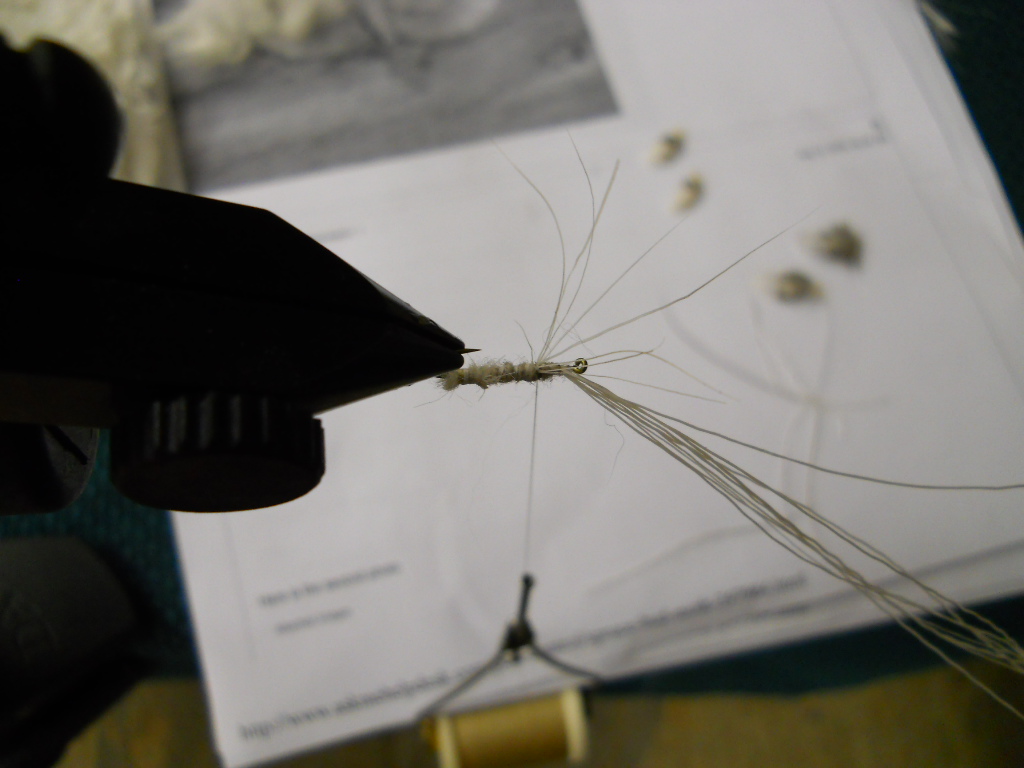
Tying in the legs.

I clipped them to length and crumpled them. Caribou and moose hair are both hollow so they look segmented when they are crumpled.


The underwings are tied in.

And the over-wings.

The antennae are tied in, I whip finished it and cemented the head. 

Then I tied some more.
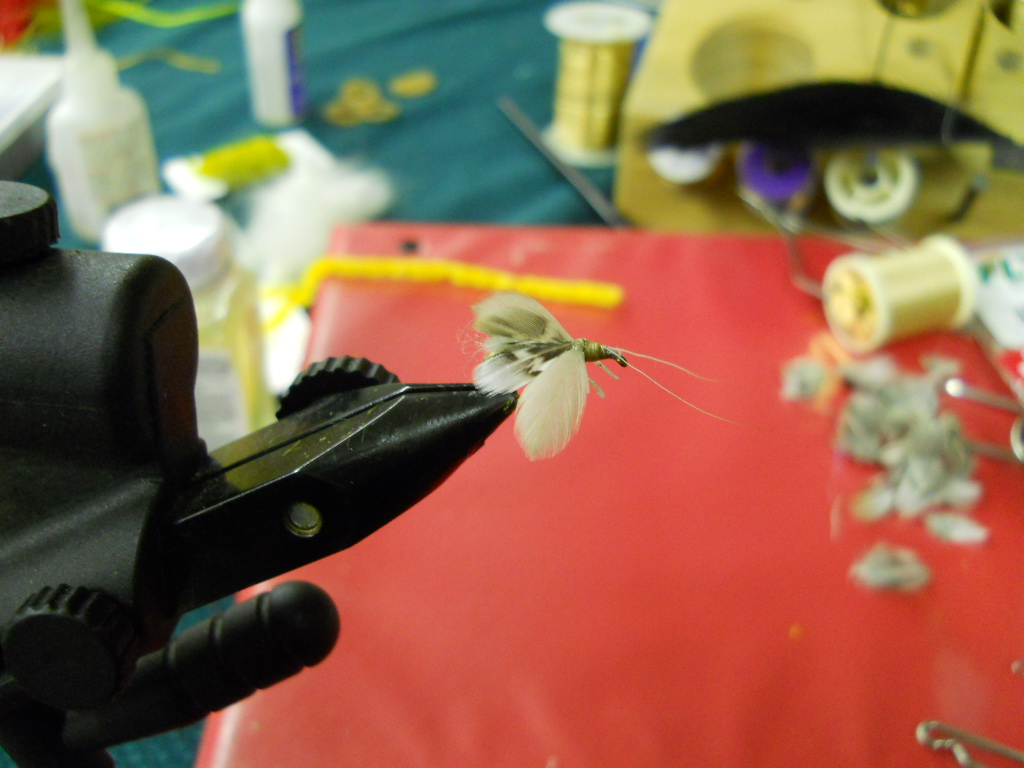
I've seen moths in the water with one wing out and one wing in, so I tied one. The "spent" variation, or crippled one.

I'm sure they fall in up-side-down, so I tied the "wheels-up" variation.

Here are the moths.

Next, the bees.

Friday, May 11, 2012

The challenge

I received a fly tying kit for Christmas and started to tie flies the same day. The kit did not come with hooks, so I got some from my tackle box. I didn't pay much attention to hook size or style, I just tied flies. I tied some of each of the kinds of flies in the instruction book.

 I looked at tutorials on the web and tied them. I bought more materials and books and tied more patterns.
Soon I began to tie patterns that I had not seen but resembled prey species that I had seen in stomachs of fish I was cleaning.
I tied patterns that resembled (or that I imagined resembled) pike, salmon fry, eels, frogs, and smolt. I tied bead-head scuds and bug-eyed nymphs

Sometime along the line I thought it would be a great idea to catch each of Alaska's game fish with a fly tied by myself, even better if it was one of my own patterns.

The challenge

So the challenge is to catch each of Alaska's game fish species with a fly tied by myself, one of my own patterns, with traditional fly tackle.

The list

Here is the official list of Alaskan sport fish species from the Alaska Department of Fish and Game;

Fresh Water:


There are different lists of Alaska game fish, they vary a little from list to list. Some of them call rainbow trout and steelhead the same species, for my purposes I am going to count them as two different fish. One list showed Dolly Varden and Arctic Char as the same fish, they are actually two separate species and I am going to count them as two fish. One list showed Burbot and White fish as game fish, so I am going to count them.

So, my official list of Alaskan game fish species is;

Arctic Char
Arctic Grayling
Northern Pike
Sheefish
Burbot
Round Whitefish
Humpback Whitefish
Broad Whitefish
Dolly Varden
Lake trout
Rainbow trout
Steelhead
Cutthroat Trout
Brook Trout
Halibut
Black Rockfish
Yelloweye Rockfish
Sablefish
Lingcod
Salmon Shark
King Salmon
Silver Salmon
Sockeye Salmon
Pink Salmon
Chum Salmon

Some of these fish are commonly sought after by fly fisherman, I am sure some of them have never been recorded as having been caught by a fly fisherman. Some of them will be easy to catch. Some will be caught incidentally while targeting other species. Sablefish, Salmon Shark and Burbot will probably be the most challenging.

The Rules

Since it's my game, I guess I get to make the rules. All of the fish will be caught using traditional fly fishing tackle and methods on flies that I tied. It's nearly impossible to know if a fly pattern is an original, for that reason I will not hold myself to that stipulation. I think it would be fun to catch as many species as I can on patterns that I developed, so I will do it with flies that I have not seen others tie. I am sure many will be similar to flies that other people have tied.
All fishing seasons and regulations will be adhered to.
Much of the fishing will be self guided, though I will absolutely need to charter some airplanes and boats.
I will not use down riggers or extra weight on the flies though I will use weighted flies.
I will not use bait or scent, I will allow myself to use fish I have caught to enhance the smell of the flies.
I will not use power to chase fish, shoot or harpoon fish. I will use a landing net where practical and a tail-loop, if necessary.
Most of the fish will be released unharmed, if one is injured it will be eaten and some will be saved for meals.

More on the flies later.

Friday, April 27, 2012

The idea here is to catch each of Alaska's game fish on a fly tied by myself. Here's how it started

I had dabbled in fly fishing when I was a kid, for sunfish and other species. I vaguely remember receiving a fly tying kit for Christmas or a Birthday too, but that was it for a while. The interest was always there though, in the background, waiting.

In the summer of 2010 my wife Angel and I were invited on a fly fishing float trip for grayling with our good friends, Bob and Kathleen Hook. We floated the upper Chena River (pronounced "Cheena", we locals are always irritated when people pronounce OUR stuff wrong) and had a wonderful time. The weather was great, the company was better and the fishing was super. I am sure we caught over a hundred fish and as I remember some of them were pretty nice fish. At the end of the day Bob and Kathleen gave me the rod that they had loaned me for the day and I was hooked.

In August of 2011 a friend of mine, Mike Bracken and I floated the Salmon Fork of the Black River for seven days. It's a remote tributary of the Porcupine on the Arctic Circle with it's origin near the Canadian border. We floated for seven days and never saw another human being, no cars, no phones and the only airplanes we saw were the two that were at 35,000 feet.


My buddy Joe Mattie, dropped us off in his float plane on the Salmon Fork of the Black, my old trapline.


This is the start of the trip, the river, our set up, the beautiful weather. That's me.
We had a great time, we fished with mostly spinning gear but I brought my fly rod along and gave it a try later in the trip. Within minutes, the first fish was hooked, a sheefish.
After a while we were catching so many fish we cut some of the hooks off of the lures and crimped the barbs down. All of the fish were released until we needed some for a meal. There was no way to save them, and really, you can only eat so many. Can you see the beginnings of a fly fisherman starting to emerge?


In the early part of the trip we caught sheefish and grayling. By the end of the first day we came to a place where a high bank was being eroded by the river. An ice lens from the last ice age is visible in the bank and remnants of fauna from the Pleistocene age can be found along the river.
That's my buddy Mike checking out the ice lens. We found a piece of a mammoth tooth, and some steppe bison and mammoth bone pieces.

In the days to come we saw lots of wildlife, we never heard an un-natural sound that we didn't make and we kind-of by second nature went into semi-stealth mode. We spoke, but quietly, we made no un-necessary noises. We floated up on game that didn't know we were there, and we were in a bright blue boat.
In all, we were within 100 to 15 yards of 11 black bears and one grizzly, we saw swans, moose, coyotes and lots of birds of prey, bald and golden eagles, osprey, perigrin falcons, and owls and hawks of all kinds.

We fished our way down the river, keeping only the last few fish we caught before making camp, or the ones that got injured. We took steps to harm them less and make fishing more challenging. Mike was fishing without setting the hook. There were very few places along the river you could not catch a fish.
One of the pike that got injured, he's not big, but he's enough for two people.

In many things, not just hunting or fishing, when you first start out, more is better. If photography is your hobby the more pictures you can take the better, after a while, when you've taken enough, you look for better shots, some that no one else has taken yet, something different, something better. There comes a time when quantity is no longer the point, but quality and the pursuit of it has the emphasis. When I had gotten enough grouse to eat with a shotgun, I began to shoot them with a pistol. When I had killed enough deer with a rifle I started to hunt with a bow. I have had more fun hunting with a bow and not killing as much, than I did when I killed more with a rifle. I hunted more with a bow and I hunted more skillfully. The quality of the hunt was better.

Fly fishing is the same, I don't have to catch 100 fish a day, though you still can in fly fishing. I can get more satisfaction from fishing with a fly that I tied, especially if it's a pattern that I developed.

I got a fly tying kit for Christmas again, some forty years after my first one, so now, I can extend this pursuit through the winter months. I will show you some of my patterns and how they came to be.

Sometime along the way I decided I should catch each of Alaska's game fish on a fly that I tied. The list includes the salt water species, as well as fresh, the ones commonly sought by fly fisherman and some that may never have been caught on a fly. It will be a challenge to be sure.