Monday, August 5, 2013

The Flies of Sitka

    We used two different flies , the Klag Island Squid and the e-FISH-ency Needle Fish when we fished the waters north of Sitka for Rockfish and other species. I will be showing you how to tie these two and a third one the Braided Herring, that we will try next time. On the Sitka trip, I was able to add four species of salt water game fish to my tally, the Black Rockfish, the Dusky Rockfish, the Quill Back Rockfish and the Halibut (though the halibut will need some improvement before I can give myself full credit for it)

My tally after the Sitka trip looks like this;
GRAYLING on... Spruce Worm Bud Moth, Egg Butt and Egg Head Scud, Egg Butt and Egg Head Nymph, Pink Bluff Chub and Salmon Fork Smolt.
RAINBOW on Egg Head Scud
SOCKEYE  No name red salmon pattern I will call Noname (pronounced "No nah me")
NORTHERN PIKE Pink Bluff Chub and Salmon Fork Smolt
SHEEFISH Salmon Fork Smolt
BLACK ROCKFISH on Klag Island Squid, the e-FISH-ency Needle Fish
DUSKY ROCKFISH on Klag Island Squid
QUILL BACK ROCKFISH Klag Island Squid
HALIBUT (needs improvement) Klag Island Squid

    At the top, left is the Braided Herring, top right the Non-Pelagic e-FISH-ency Needle Fish and bottom, the Non-Pelagic Klag Island Squid

We used a squid imitation and bait fish patterns. Since we were fishing near the bottom for bottom fish, snagging on the bottom was a problem. I had not tied any weedless versions for our first trip but I will be tying some in this tutorial.
    Our most productive pattern was the squid immitation, on it we caught pelagic and non-pelagic rockfish. A pelagic fish species is one that lives suspended in the water colomn, not near the bottom or the shore. I will be calling my weedless version of the squid imitation the Non-Pelagic Klag Island Squid since it will be fished near the bottom and Klag Island is a major island near where we first used this fly with great success.

Tying the Non-Pelagic Klag Island Squid

main hook               3/0 spey hook
trailing hook            2/0 octopus hook
body                       white chenille
eyes                        brass dumbbell eyes and 3-D holographic eyes
trailing wire
tail and tentacles       white marabou, white saddle hackle, pearlescent krystal flash, cashmere goat fur
weight                     .035 lead wire
thread                     pearlescent white

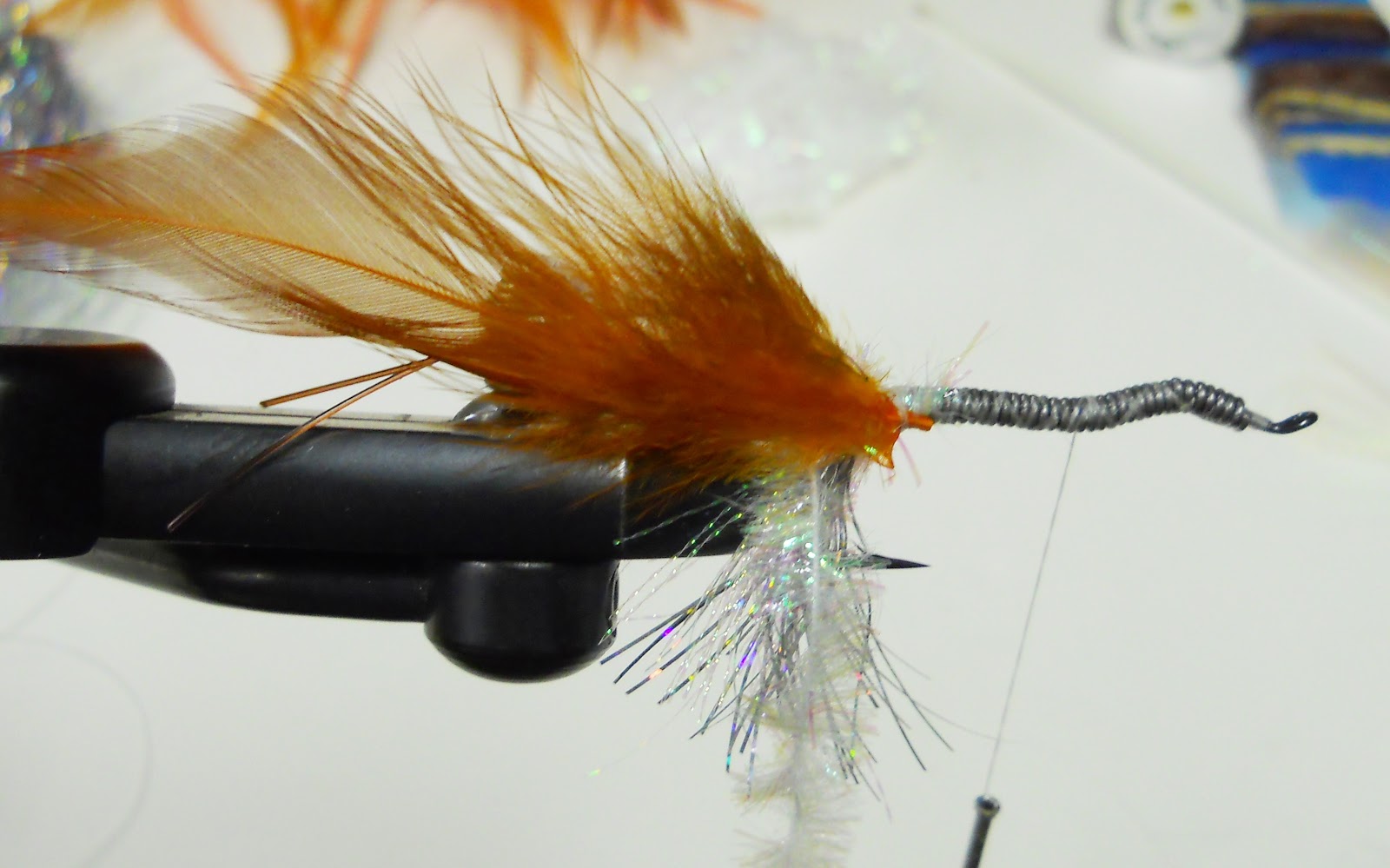
Begin by cutting the eye from the hook and dressing it to the bend with white thread Cut a section of trailing wire about 5 inches long and tie it down with about two inches extending past the bend of the hook. This will serve as both the trailing wire and the weedless loop.
 Tie in some Krystal flash or flashabou for some sparkle in the tail.
Dress it with white marabou for action.
Tie in the chenille and the lead wire at the start of the bend.
Wrap the lead wire to the cut-off end of the hook. Use head cement on the lead wire to create a durable fly.
Wrap the chenille to cover the lead wire and tie it off. Loop the trailing wire along the side of the bend of the hook and tie it off at the cut off end of the hook to create a snag guard. Whip finish and cement.
Set the trailing hook aside to dry while you prepare the main hook.
Dress the shank of the main hook to the start of the bend with white thread,tie in the trailing hook about a inch away from the main hook with the hook up. tie in a three inch piece of trailing wire for the hook guard on the main hook and tie in the lead wire at the start of the bend.
Tie in all the tentacle materials, the cashmere fur, rooster hackle, flashabou etc.

Wrap the lead wire to within 1/4 inch of the eye and wrap the thread to a point one third the length of the shank toward the eye.

Tie in the dumbbell eyes at the one third point using figure eight wraps and finish wrapping the thread to the eye of the hook. Use head cement under the lead. I like to flatten the ends of the dumbbell eyes to give the adhesive eyes a flat spot to stick to.
Wrap the chenille to the eyes and around them using figure eights, then to the eye of the hook. Tie down the second piece of trailing wire to form a hook guard, whip finish and cement. Glue in the eyes, when the glue dries, put several coats of head cement over the eyes to make sure they stay on.
 
I have a really great trip to talk about in the next post so I will come back to the tutorial on the e-FISH-ency Needle Fish and the Braided Herring at a later date.

Thanks for visiting.


Saturday, June 15, 2013

SITKA, JUNE 9TH-13TH

    Oh my gosh! the trip to Sitka, my first big trip of the season. The lake ice in interior Alaska did not go out till early June so we haven't had a chance to do much yet. We did take out the boat for a shake down cruise on the Tanana and everything worked fine.
    A friend of mine, Rick Schikora, had invited me down to Sitka to spend a few days on his boat the "e-FISH-ency" to fly fish for rock fish and other ocean stuff. My scheduled flight at 11:00AM wasn't able to land in Sitka due to fog, so I had to wait for the next flight at 11:30PM that night. Rick met me at the harbor and we slept in the boat. We rose at an early 4:00AM and headed to what Rick and his buddies call "Deer Camp", a two hour trip from Sitka. Seas were calm and the worthy "e-FISH-ency" cruised along at 30 miles per hour, the scenery and the two hours flew by. After reaching camp we did chores for a couple of hours and headed to check shrimp pots at 8:00AM.
Captain Rick emptying a shrimp pot
Almost 300 shrimp for the first pick, that's not bad

These are some of the biggest ones
After checking shrimp pots, we headed for the fishing grounds. The winds were a little high and the ocean was too choppy for fly fishing, so we opted to fish with traditional tackle. Here's the first fish to the boat, a Black Rock Fish.
Captain Rick was finally able to catch a fish, you'd think a guy with his own boat would be a better fisherman. I think he would tell a different story, but this isn't his blog. 

Then he caught another fish, this one's a China Rock Fish
Then he caught a Yellow Eye Rock Fish, you'd think the host would save a fish for the guest to catch, but noooo......o.

There's my first Quill Back, the fishing was actually fast and furious, these fish were all within the first few minutes.
My Ling Cod. We limited out on our ten pelagic and four non-pelagic rock fish in a fairly short amount of time so we moved to other locations to find different species.
Unable to find any other species and after having been bounced around in the ocean a while longer, we headed to camp, cleaned our fish and worked on chores till bed time at 12:00PM. This is the view from "Deer Camp"
We were here to fly fish, the problem was, neither one of us really knew how to do it in the ocean. We decided we needed to set up the boat so it would drift over fish-holding structure, cast a fly ahead of the boat and allow it to sink as the boat drifted toward the structure and the fly. Our hope was that the fly would sink the 100 feet or so we needed and be at a depth needed to tickle the tops of sunken islands as we drifted over them. The plan worked and this is the first hook-up.
It was a Black Rock Fish on a squid immitation of my own design.
It can be very satisfying when a plan comes together.
Next, a Dusky Rock fish on the same pattern.

And Rick caught a Dusky too. Soon, we had it down, we would position the boat for a drift, one of us would cast from the starboard side, and move down the boat to the stern with his sinking line to clear the starboard side for the other to cast. We would continue leap-frogging each other until we had left the structure, then re-position for another drift.
I wanted to try other patterns, here's a Black Rock Fish on a bait fish immitation.

We had just about caught a limit of Rock Fish on flies when the sea strarted to get rough again so we headed to shore to take care of the fish and some other camp chores. There's never a shortage of things to do at a remote camp.
We went out for the evening tide to fish for new species and we found some. Here's a Halbut on a squid pattern. He's not real big, even if I do push him way out in front of me. I told Rick "I might have to give myself an 'incomplete' on this one. He said, "No it is complete, you might put it down as 'needs improvement'." I'll buy that.

We hit another spot Rick knew of on the way back to Sitka in hopes of catching some Ling Cod on a fly. We didn't find any Ling Cod, but the fishing was good. Here's a Quil Back on a squid.


And another one.
This was the last fish of the trip, it's a pretty nice Black Rock Fish, sometimes called Black Sea Bass. It was a great trip, the weather was wonderful, the scenery terrific and the company was quite enjoyable. I had a ball, a great thanks to my buddy Rick. In my next post, I will show how I tied these flies. I'll tie some in weedless and articulated patterns. Thanks for looking.

Saturday, January 26, 2013

Winter in Fairbanks

Well, it's winter in Alaska, it's 36 below zero outside and the best thing to do when it's that cold is tie new patterns, make plans for fishing trips in the summer and try to do a little bit of ice fishing when it gets a little warmer than 36 below.

My plans for this summer include spending quite a bit of time on the coast to get a few of the salt water species added to my tally. To that end I bought a new, used boat, it's a 16 foot, inflatable dive/rescue boat made by Mercury. I plan to spend some time in Valdez and Kenai with it, I also want to cross Cook inlet with it and spend some time at Polly reek and Crescent river, but the big expedition this year will be a trip on the ferry to Kodiak Island to spend two weeks hunting deer, brown bear and elk (if we get a permit) ducks and to especially fish all of the fresh and salt water species that Kodiak has to offer.

The major food sources for pretty much all predators is shrimp, crabs a small bait fish, I thought it would be fun to start with shrimp.
These are the first two shrimp, and the first crab.

Materials needed to tie my shrimp pattern;
Hook- Size 1-3/0 streamer, salmon fly or spey hooks
Body- .030 lead wire, crystal cactus flash chenille
Antennae- 30 Lb. red mono.
Legs and Cilia-pearlesent flashabou, hackle feather (your choice of color)
Claws- pearlesent mylar film
Shell- pearlesent mylar film or scud back
Eyes- black glass beads or 30 Lb. mono melted to form eyes.
Rib (tail segments) brass or copper wire

To begin, bend a dog-leg in the hook near the eye, this gives the finished fly a pleasing, realistic look.

The lead wire is wrapped from the start of the hook-bend almost to the eye. I used head cement to secure the weight real good, all the salt water species are quite toothy and will need well tied flies. You can vary the size of lead wire and the amount of it depending on how deep you need to fish. Most of our sport fish in Alaska are found quite deep so I'm loading on the weight.

Prepare the claws and the antennae, I cut the Mylar film with scissors and bend the mono. by carefully heating it with a lighter. The claws and antennae should roughly be about as long as the hook shank.

Tie in the claws and the antennae just behind the lead weight...

then the flashabou. It's helpful to tuck the antennae into a material holder to get them out of the way.

The crystal flash chenille and the hackle are tied down at the same place, and the thread wrapped up to the first bend of the dog-leg.


Wrap the chenille up to the first bend, tie it down and tie in a 4 inch length of wire for the tail segments.

Finish wrapping the thread and then the chenille to the eye, tie down the chenille.


Palmer the hackle to the eye and tie it down.


Prepare the shell by cutting a piece of Mylar film or scud back as shown above, it should be as long as the hook including the bend of the hook to the point. There is a small slit in the narrow section to allow the eye of the hook to pass through. The small, triangular end will form the tail of the shrimp.

Slip the eye of the hook though the small slit in the Mylar, at the base of the tail, tie the Mylar down. Starting at the first bend in the tail, wrap the brass wire, evenly spaced, around the tail section to the eye of the hook to form segments, tie the wire down and whip finish your thread.

The Mylar "shell" is held in place by my hackle pliers (viewed from the top). I have pierced through the body of the fly with my dubbing needle above the hook and about 2/3rds the length of the shank from the eye of the hook. A short section of monofilament is slid through the hole in the body. It helps make a tougher fly if a good helping of head cement is put under the "head" end of the Mylar "shell" before it is fastened down.

A black glass bead is slid onto the mono on each side of the head for eyes. The mono. is trimmed to about 1/4 inch on each side, and the ends melted with lighter to be flush with the glass bead.


The finished fly.

How many shrimp are in a plethora?

Next, I tied some articulated shrimp, hopefully for bigger game fish, halibut and ling cod, maybe.
These are tied essentially the same way with just a few exceptions. I began by putting a bend up in the hook shank about 1/4 inch from the eye.

The antennae, claws and lead are done the same way as before, two strands of 30 Lb. mono are added at the eye of the hook for the joint of the articulation.

The flashabou, the crystal flash chenille and the hackle are wrapped just like before all the way to the eye, the brass wire is tied in at the bend 1/4 inch from the eye.

The tail section is formed with a No. 4 or 6 scud hook, it is attached to the primary hook eye-to-eye by the monofilament we provided on the primary hook and lead is wrapped.

The chenille and hackle are wrapped to cover the lead and Mylar film for the shell is tied down at the bottom of the lead. I am using a cautery tool to remove unwanted material from around the eye of the primary hook to provide better access to it when the fly is finished.


The Mylar film is fastened down like before, the eye of the primary hook is poked through the Mylar at the joint, the barb of the secondary hook is clipped off and the fly is finished. This one is about five inches long, not including the claws.


This is a good start on the way to tying enough for the summer and fall.

Next time, tying crabs, herring and needle fish and learning to catch trout, salmon and char through the ice during a scud bloom.

Thanks for looking.