Saturday, January 26, 2013

Winter in Fairbanks

Well, it's winter in Alaska, it's 36 below zero outside and the best thing to do when it's that cold is tie new patterns, make plans for fishing trips in the summer and try to do a little bit of ice fishing when it gets a little warmer than 36 below.

My plans for this summer include spending quite a bit of time on the coast to get a few of the salt water species added to my tally. To that end I bought a new, used boat, it's a 16 foot, inflatable dive/rescue boat made by Mercury. I plan to spend some time in Valdez and Kenai with it, I also want to cross Cook inlet with it and spend some time at Polly reek and Crescent river, but the big expedition this year will be a trip on the ferry to Kodiak Island to spend two weeks hunting deer, brown bear and elk (if we get a permit) ducks and to especially fish all of the fresh and salt water species that Kodiak has to offer.

The major food sources for pretty much all predators is shrimp, crabs a small bait fish, I thought it would be fun to start with shrimp.
These are the first two shrimp, and the first crab.

Materials needed to tie my shrimp pattern;
Hook- Size 1-3/0 streamer, salmon fly or spey hooks
Body- .030 lead wire, crystal cactus flash chenille
Antennae- 30 Lb. red mono.
Legs and Cilia-pearlesent flashabou, hackle feather (your choice of color)
Claws- pearlesent mylar film
Shell- pearlesent mylar film or scud back
Eyes- black glass beads or 30 Lb. mono melted to form eyes.
Rib (tail segments) brass or copper wire

To begin, bend a dog-leg in the hook near the eye, this gives the finished fly a pleasing, realistic look.

The lead wire is wrapped from the start of the hook-bend almost to the eye. I used head cement to secure the weight real good, all the salt water species are quite toothy and will need well tied flies. You can vary the size of lead wire and the amount of it depending on how deep you need to fish. Most of our sport fish in Alaska are found quite deep so I'm loading on the weight.

Prepare the claws and the antennae, I cut the Mylar film with scissors and bend the mono. by carefully heating it with a lighter. The claws and antennae should roughly be about as long as the hook shank.

Tie in the claws and the antennae just behind the lead weight...

then the flashabou. It's helpful to tuck the antennae into a material holder to get them out of the way.
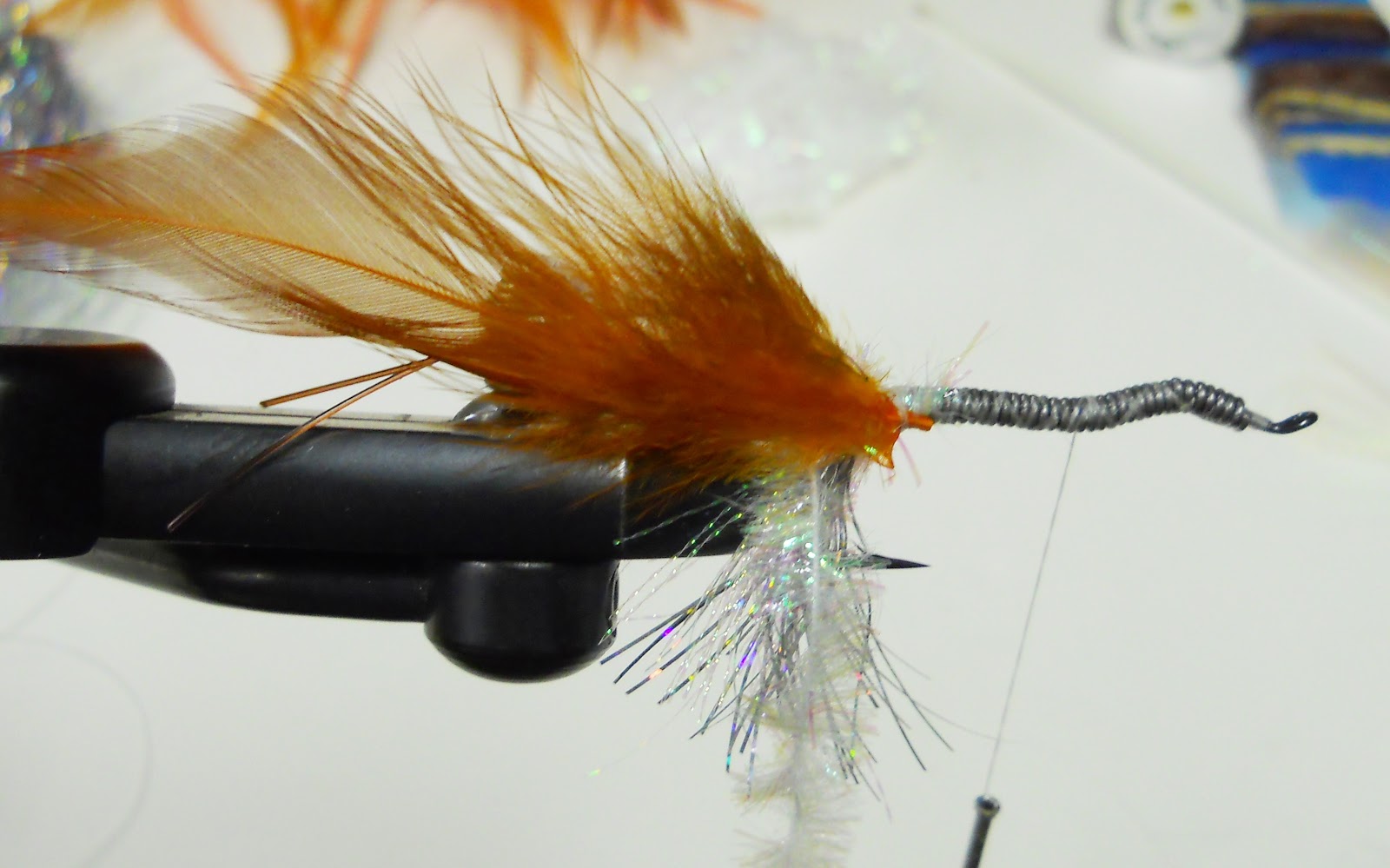
The crystal flash chenille and the hackle are tied down at the same place, and the thread wrapped up to the first bend of the dog-leg.


Wrap the chenille up to the first bend, tie it down and tie in a 4 inch length of wire for the tail segments.

Finish wrapping the thread and then the chenille to the eye, tie down the chenille.


Palmer the hackle to the eye and tie it down.


Prepare the shell by cutting a piece of Mylar film or scud back as shown above, it should be as long as the hook including the bend of the hook to the point. There is a small slit in the narrow section to allow the eye of the hook to pass through. The small, triangular end will form the tail of the shrimp.

Slip the eye of the hook though the small slit in the Mylar, at the base of the tail, tie the Mylar down. Starting at the first bend in the tail, wrap the brass wire, evenly spaced, around the tail section to the eye of the hook to form segments, tie the wire down and whip finish your thread.

The Mylar "shell" is held in place by my hackle pliers (viewed from the top). I have pierced through the body of the fly with my dubbing needle above the hook and about 2/3rds the length of the shank from the eye of the hook. A short section of monofilament is slid through the hole in the body. It helps make a tougher fly if a good helping of head cement is put under the "head" end of the Mylar "shell" before it is fastened down.

A black glass bead is slid onto the mono on each side of the head for eyes. The mono. is trimmed to about 1/4 inch on each side, and the ends melted with lighter to be flush with the glass bead.


The finished fly.

How many shrimp are in a plethora?

Next, I tied some articulated shrimp, hopefully for bigger game fish, halibut and ling cod, maybe.
These are tied essentially the same way with just a few exceptions. I began by putting a bend up in the hook shank about 1/4 inch from the eye.

The antennae, claws and lead are done the same way as before, two strands of 30 Lb. mono are added at the eye of the hook for the joint of the articulation.

The flashabou, the crystal flash chenille and the hackle are wrapped just like before all the way to the eye, the brass wire is tied in at the bend 1/4 inch from the eye.

The tail section is formed with a No. 4 or 6 scud hook, it is attached to the primary hook eye-to-eye by the monofilament we provided on the primary hook and lead is wrapped.

The chenille and hackle are wrapped to cover the lead and Mylar film for the shell is tied down at the bottom of the lead. I am using a cautery tool to remove unwanted material from around the eye of the primary hook to provide better access to it when the fly is finished.


The Mylar film is fastened down like before, the eye of the primary hook is poked through the Mylar at the joint, the barb of the secondary hook is clipped off and the fly is finished. This one is about five inches long, not including the claws.


This is a good start on the way to tying enough for the summer and fall.

Next time, tying crabs, herring and needle fish and learning to catch trout, salmon and char through the ice during a scud bloom.

Thanks for looking.

Thursday, November 15, 2012

The last two trips before the water got hard. The Chatanika for white fish and the Kenai for rainbows and char.

In September in interior Alaska pretty much everything comes to a screeching halt so everyone can take some time off for moose hunting. Mike and I still had some moose meat from previous hunts and didn't feel an overwhelming need to shoot one, but we did need some more time out on the river. We planned to float a section of the lower Chatanika River just north of Fairbanks. We decided to do a three day float from the Elliot highway bridge to the landing at Murphy Dome Rd. The Chatanika River has a good population of grayling and white fish. My idea was to add the later to my tally and shoot a couple of ducks to give my Chessie/ Lab mix puppy of seven months some work on ducks from a boat. Mike would bring one of his hunting pistols, a Remington XP100 in 350 Rem. magnum, just in case a cooperative moose presented himself on the bank and we just couldn't pass him up. We did, however, agree that the best way to ruin this perfectly good float trip would be to shoot a moose on it.

The weatherman promised three days of balmy, sunny weather before the first big storm that would start winter in interior Alaska, with that in mind, we launched the boat on a partly cloudy day with the sun trying to shine through in places.


Bessie my seven month old Chessie/Lab mix learning about boats.

The Chatanika in fall colors. The weather started out pretty good on the first day but deteriorated fast, we didn't get the weather we were promised. It got cold and windy and we had to fight a two day head wind, fortunately we had a small outboard to help with it.


Bessie styling in her new Browning float coat.

The haul-out at Murphy Dome road. I wasn't able to add any new species to my tally, the water was high and murky, a condition that makes it hard to locate and fish white fish. I did catch some grayling on Moths and Egg Butt Scuds. I shot some ducks for Bessie to work on, at first the cold, turbulent water startled her, but she did very well on her water retrieves after she got used to it. We didn't see a moose to shoot, and we were not unhappy about it. The journey was kind of arduous as it was without adding a moose to the mix. I will have to wait for next year to try again for white fish, and probably do the float in four days instead of three.

The Kenai for rainbows
On October 18th I was headed down to Kenai to an NRA banquet where I was donating two of my 1911 knives (I am a custom knife maker) for their fundraiser. I was thinking it would have been a shame to make a trip down to the Kenai without spending at least a little bit of time with my butt in a boat. It was very near the end of the fish guiding season, but we were able to find a guide with an opening on Saturday morning.
We met our guide Jason Westmiester (that's his drift boat to the left) at the lower Skilak landing to drift the middle section of the Kenai for rainbows and char. The temperature was right at freezing, but it was supposed to be a sunny day. Come on sun.


Ever-present eagles. We drifted with bead-egg imitations under strike indicators and got bites from time to time. We caught some small char, but the rainbows were cagey. Finally Mike hooked into something that looked really good.


Jason and Mike with his 28 1/2 inch steelhead, a very nice fish for our guides second to last fishing day on the Kenai this fall, and Mikes first steelhead.

Jason releasing the nice steely. It was the only one we caught, but it made the trip worth it.


Spawned-out salmon in the headwaters of the Kenai waiting to die and add nutrients back to the land and water.


Flesh from spawned-out salmon in the upper river. Flesh flies are effective for trout and char in the mid to late season. It's important to know what it looks like in order to be able to tie good imitations.

Some very large brown bear tracks along the creek where fish are dieing. As I am writing this in mid November, we are hearing news of two trappers on the Kenai that were just mauled by a brown bear while setting for coyotes. Bears are late getting into the den when food is plentiful.


The sun sets on another beautiful day on the Kenai, our last one for the season. I can't wait to get back. Over the winter I will work on some soft, weighted egg imitations. My idea is to make egg imitations that drift naturally and remove the strike indicator and the split shots from the set-up so that my line will go straight from my rod tip to the fly. Hopefully, I'll be able to sense a strike and react before the fish realizes he has a fake in his mouth. I'll show some of what I'm developing in a future post. I will also work on some flesh fly and flesh fly/egg pattern combinations.

Stay tuned for fly tying through the winter. I will be testing some patterns through the ice this winter, but will not add any fish caught to my tally because I will not be able to use traditional fly fishing methods.

Thanks for looking. Mark

Monday, September 3, 2012

The Salmon Fork 2012

Ah, the the big trip of the summer. Mike and I have been anticipating this trip since we got back last year. A week with no phones, no noise and nothing to worry about. Silence and solitude would be ours for seven days.

I wanted to try out some new fly patterns, add a couple of species to add to my list and maybe catch a big pike on a fly.


We were dropped off close to the normal spot above Pink Bluff and soon after the drone of the Cessna 170 faded away over the hills on the first shuttle I settled into a different rhythm, a slower pace with nothing on my mind but whatever I wanted to do, nothing urgent to take care of, when we got hungry, we ate, when we got tired we slept. I decided to fish and caught this grayling on a Spruce Bud Worm Moth.

Most of the Salmon Fork is fishable water, before our second and third shuttle with the float plane I had caught several grayling in the hole that the plane landed in. This is the first fish caught on this pattern, a woven mylar tube minnow I dubbed the Pink Bluff Chub. The pattern would prove to be very productive in the next week for grayling, sheefish and pike. Watch for a recipe for the Pink Bluff Chub in a future post.


Here's our rig for the next week, everything we will need to be fairly comfortable, whatever the conditions.

I had three fly rods with me, a 9 weight with fast sinking line for getting into the deep pools for sheefish and pike, a 5/6 weight set up for surface fishing and a six weight for shallow water under the surface.

Red salmon from the trip to Kenai.

Shore lunch.

This is one of the spots that had pike, sheefish and grayling all in the same hole, it's usually not easy to find places like that but the Salmon Fork has a few. These fish were all hitting on the same fly, the Salmon Fork Smolt, another new pattern. It was tied with these holes in mind, it resembles a salmon smolt, small grayling or rainbow trout. It was really a hit on this river and should be productive anywhere that small spotted fish are a predominant prey species. I will tie a Salmon Fork Smolt for you in a future post.

Sheefish on the smolt.

A grayling on the Salmon Fork Smolt, the biggest grayling we measured on the trip was 16 1/2 inches long, really nice fish.

Here's the biggest of the pike I caught this week, it was 32 inches long.

We weren't able to get down to the lower river where we have caught pike up to 45 inches long due to a two day head wind, so the bigger fish will have to wait for another trip.

This is a different variation of the Salmon Fork Smolt, I tied some with barred-feathers instead of spots, some weighted ones and some articulated ones. They all did well, but the best ones had spots.

I can never get enough of the sunrises and sunsets.

My tally to date;
GRAYLING on... Spruce Worm Bud Moth, Egg Butt and Egg Head Scud, Egg Butt and Egg Head Nymph, Pink Bluff Chub and Salmon Fork Smolt.
RAINBOW on Egg Head Scud
SOCKEYE  No name red salmon pattern I will call Noname (pronounced "No nah me")
NORTHERN PIKE Pink Bluff Chub and Salmon Fork Smolt
SHEEFISH Salmon Fork Smolt

Next time, tying some of these patterns and maybe some silver salmon, char, and rainbow fishing.


Wednesday, August 15, 2012

Sockeye fishing on the Kenai


After three attempts at reds, Mike and I finally got some. Our first try was in the Kenai when we were down to Homer for a halibut fishing trip. We were able to catch halibut on deep sea gear but we were between runs of sockeye. Our second attempt was on the Gulkana where I had fowl hooked two, I wasn't able to catch any in the mouth and had to give myself an incomplete.

Finally toward the end of the second Kenai run of reds we were able to catch some. I decided to hire a guide to run the boat so that I could concentrate on fishing and learn something about the river. We worked till 6:00 on Tuesday the 7th. and drove through the night to meet the boat by 4:00 in the morning at Sterling. We were at our fishing spot by 5:00. Mike caught our first fish which also turned out to be our biggest one.

Fighting my first red, it's important to keep your hand off of the reel while the fish runs to allow the drag to work. It's easy to loose these fish because they are tenacious fighters. The fights can be explosive with line stripping runs, and surface acrobatics.

Here's our fish guide Alex netting one of the many fish we caught that day, we fished with Drifters Lodge of Coopers Landing, the accommodations are great, the guides are outstanding and the fishing was exciting. I highly recommend Drifters Lodge for anyone wanting to fish the Kenai.

These reds were in great shape, fresh from the sea, they still had sea lice on them.
It's not necessary to have a pretty fly to catch reds, in fact anything will do but a pretty fly makes a pretty picture, and who wants to tie an ugly fly. These reds are tough on flies, a good coat of head cement over the body will help hold the fly together through the toothy fight.


Here's our ten, two short of a limit, plenty of really nice fish for the winter.

Here's some shots of spawning sockeye's that Mike took.

The whole area is full of picturesque scenes like these.

We can't wait to get back again but we will have to do it again next year, we leave for our next big adventure in a couple of days, a week long float trip on the Salmon Fork of the Black for grayling, sheefish pike and maybe whitefish and burbot.

My tally to date;
Grayling on three original patterns, the Spruce Bud Worm Moth and the Egg Head and Egg Butt Scud.
Rainbow on one, the egg head scud.
Sockeye on two original sockeye patterns.

I have had some thoughts on my original species list and will need to amend it. In my list of the 25 species of my quest, I listed three species of white fish as well as grayling and sheefish which are also white fish, at the same time only listing rock fish once, of which there are thirty species. It seems inconsistent to cover the white fish so thoroughly and give the rock fish such poor respect. I wouldn't want to say that white fish are lower in fish hierarchy than the rock fish but, rock fish are really cool and deserve at least as much respect. I have decided to list grayling and sheefish because they are major white fish species, all the rest of the lesser white fish as one and all of the rock fish as one, then give myself extra credit for each of the lesser white fish and rock fish species that I catch.

Tuesday, August 7, 2012

Floating the Gulkana

The whole state of Alaska had a very poor king salmon run this year, all of the drainages were limited to catch and release and some on drainages you were not even allowed to target them, so my salmon fishing for the summer has been for reds. I will concentrate on other species next summer.

Mike and I had been invited to Homer for a halibut fishing trip on June 12 this year, we brought our salmon gear with us in the hopes that we could catch some reds in the Kenai while we were down there. As it turns out, we got there between the runs. We fished but were not able to hook anything, we didn't even see any fish caught, though there were a few people trying.

So here's the thing about salmon fishing, timing is everything. With most other species, persistence can pay off. If you work at it hard enough and long enough you can get something to bite. With salmon, if you're there at the wrong time you are just not going to catch a fish.


With good reports coming from the Gulkana of decent returns of red salmon and hopes of catching some rainbows, Mike and I planned a quick trip. We left Fairbanks at 2:00 PM on July 7 and were on the river at  8:00 that evening. We floated for a couple of hours before pitching the tent for the night.

Gearing-up at the Sourdough boat launch with high hopes. I had a 9 weight with sinking line set up for reds, and two 5/6 weights, one set up for dry flies and the other with wet flies.

We woke at six to this beautiful misty morning, it had frosted over night.

We floated and fished hard for half the day, stopping at promising looking pools. I finally caught my first red, unfortunately, it was not hooked in the mouth. In Alaska, any fish hooked in any place other than the mouth has to be let go, so of course we did.

Soon I hooked another one, it was a real good fight with the swift current....


and I had hooked this one by the back too. Had to let it go.


We fished a total of seventeen hours on the river and never hooked another red salmon, but the grayling were always willing participants. They were hitting the egg head and egg butt scuds all the way down the river. It is very hard to run the boat and fly fish at the same time, I will need to fish with someone else running the boat a little.


With my polarized lenses I should have seen salmon if there were any in the river, I didn't see any but we did see a cow and calf moose....

a black bear that didn't really know how to handle us and a grizzly bear that we didn't get a picture of. I didn't catch any rainbows or incidental king salmon, the season was closed on both of them due to low numbers and I didn't catch a red that I could keep but it was a nice trip. I haven't given up for the season yet though, tonight Mike and I leave for a guided trip on the upper Kenai for rainbows, char and red salmon.